The sight of a farmer letting golden grain fall through their aged hands is truly heart-touching, as one can tell that such grains are going to be transported thousands of miles to feed families who will never meet the farmer. This has been our situation at Glee Impex Pvt Ltd for several years now. As an Indian grains exporter, We were lucky enough to connect two different worlds by linking India’s long-standing agricultural tradition with the global market, which is now more and more appreciating the true, quality food. Reviewing shipment manifests sometimes makes me think of how this trading of grains, though simple, is something more than just a transaction. It entails keeping traditions, helping people’s living standard, and showing consideration to the land, farmers, and the ones who will be cooking the grains.

Should you have never visited rural India at the time of harvest, then you have really missed one of the most wonderful sights. Not only is it one large area of scenery, it is also hundreds of kilometers of scenery that keep on changing—the first ones being the green rice fields, then the golden wheat, and at last the drought-resistant millet in the dry regions.
Last summer, I recall I was at the home of a millet farmer in Rajasthan. The temperature was around 45 degrees and I was so tired and uncomfortable, but he looked totally fine and even energetic while telling me how the harsh conditions are making his green millet stronger. “Soft conditions produce soft crops,” he grinned. That conversation flipped my thinking about agriculture—it’s not merely a matter of producing food; it is knowing the intricate connection between environment and the characteristics of crop.
The range of the Indian subcontinent goes from the humid coast to the cool mountain and the hot desert. During the long periods of history, the agriculturalists have perfected the varieties of cereals that are most suitable to every single microclimate. The basmati rice produced in Punjab has a unique flavor compared to the cultivation done in other regions—not for the reason of using different seeds, but because of the variation in soil, water, and atmosphere. Terroir is not just a notion for wines; it applies to cereals significantly too.
Here’s something that gets me excited—millets are finally having their moment. For millennia, these cereals have been the staple food of Indian civilization and have been silently performing their work while eye-catching crops attracted the attention. Today, nutritionists all over the globe are unveiling the secret of our grandmothers: millets are superfoods.
Green millet (bajra) and yellow millet aren’t just healthy—they’re remarkably resilient. They grow where other crops surrender. Drought? Not a problem. Poor soil? They adapt. This resilience matters more each year as climate patterns become unpredictable.
Sorghum has a similar story. For a long time, it was thought of as a “poor man’s grain,” which was a big mistake because such a view totally ignored the benefits of sorghum. It is a naturally gluten-free, very nourishing, and delicious crop. Its being sold in health food markets feels like justice—finally, this grain that was so good got its due.

Let me tell you about basmati rice. Anyone can sell rice, but basmati requires understanding, patience, and genuine appreciation. As a premium-grade grain exporter, we’ve spent years learning proper basmati handling nuances.
There are negative consequences if one tries to speed up the aging process, which are very much visible when someone cooks the rice. The best basmati has to go through a long process before it reaches the consumer with its characteristic smell, perfect elongation of each grain and a texture that is at the same time firm and delicate. We live farmers whose families have been doing this for ages. They are not just suppliers; they are artists whose skills cannot be taken just over by machines.
Last month, a buyer asked why our basmati costs more. Fair question. I sent them samples of properly aged basmati alongside cheaper alternatives. They never asked about price again. Quality speaks for itself.
The grain export business is brutally competitive—I won’t sugar-coat that. So what distinguishes us as a leading grain exporter in India? It consisted of a combination of rules, tactics, communications, and a firm determination to take the right path, no matter how much easier the other options were.
We mean it when we say that we are a clean and natural grain supplier. These are operational commitments and not just marketing buzzwords; they are the ones that unite daily decisions in our company. A long time I have been meandering around our places, watching quality control, and being that pesky person who keeps on asking, “But why do we do it this way?” Quality is initiated by the farmers who know that proper harvesting, storage, and careful handling are not an option of fussiness but a must of discipline. Our processing facilities handle each grain variety according to its specific requirements. Being recognized as an exporter of quality grains means these systems work flawlessly every day, not just when we’re paying attention.

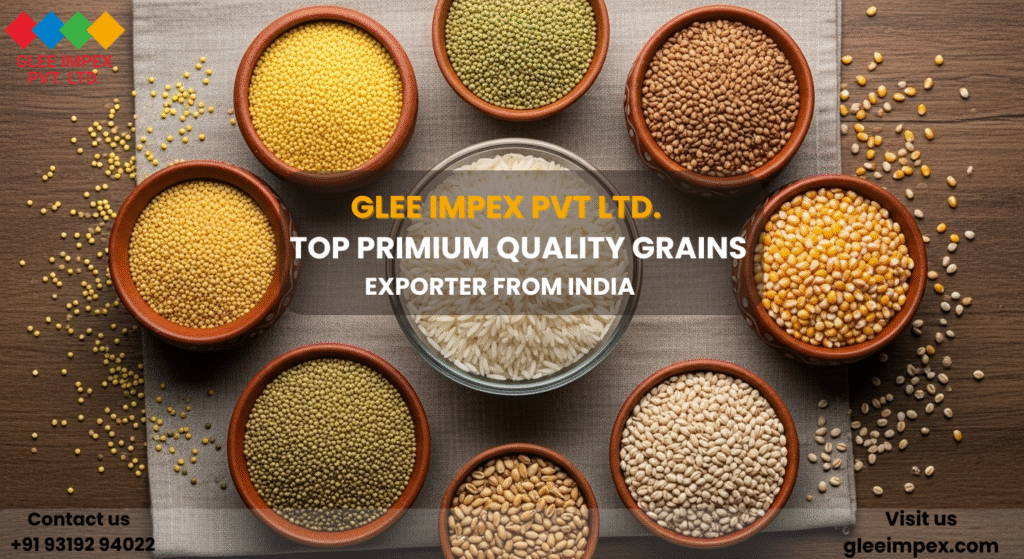
We’ve built our range based on what markets need and what we can source reliably. Basmati rice anchors our portfolio across multiple grades. Non-basmati rice varieties like sona masoori, IR-64, and parboiled rice are essential for daily nutrition. Millets—green millet (bajra) and yellow millet—have seen explosive demand growth. Sorghum appeals to health food markets seeking gluten-free options. Barley (jau) serves brewing, health foods, and animal nutrition. Yellow maize fulfills food-grade and industrial applications. Gaur seed is valuable for culinary and industrial uses like guar gum production.
Becoming an Indian grains exporter people trust took more than deciding to ship products overseas. It required developing expertise in international regulations, complex logistics, quality protocols, and market intelligence. We’ve built this gradually, learning from successes but honestly learning more from mistakes.
Quality assurance means establishing systems that identify problems before they affect shipments. Different countries have different requirements. Regulations change. As a premium-grade grain exporter, we’ve developed deep expertise handling these complexities so our partners don’t have to navigate them independently.
Grain markets keep changing all the time weather to crops to consumers to logistics. For the case of India being a leading grain exporter staying updated is not a choice it is a necessity. We do all that by following production forecasts, keeping an eye on prices, getting to know the buyers, and sharing the knowledge which helps the whole lot in making better choices.
Consistency is critical. Buyers build operations around expected deliveries. That’s why we maintain relationships across multiple growing regions, keep buffer inventory, and have flexible logistics arrangements. Real reliability shows itself when circumstances get challenging.

Being an exporter of quality grains means viewing clients as genuine partners whose success connects to ours. We accommodate packaging requirements, work collaboratively on quality parameters, and provide detailed product information because informed decisions serve everyone better.
Whenever there are issues—and they do occur at times—we tackle them head-on and without delay. We do not make any defensive excuses nor shift blame to others. Trust is built through the consistency of actions commensurate with the stated values. A few of our oldest clients have turned into friends—we share the joy of achievements and give each other a hand in times of hardship.
Being a clean and natural grain supplier requires thinking beyond immediate transactions. We encourage farming that is beneficial to the soil, consumes water wisely, and minimizes the use of chemicals as far as possible. These techniques are not merely the environment’s concerns; they are the requirements of the sustainable agriculture in the practice area.
The consumers are and have been asking for a while now to learn more about the way their food was grown and the impact of their choices. We want true tales to narrate—not marketing lies but the real picture of responsible practices that we genuinely stand behind. Supporting farmers who are looking after their fields not only secures our business but also goes hand in hand with our values.

Moving grains from Indian fields to global markets requires constant vigilance and unwavering commitment to quality. As a premier Indian grains exporter with years of experience, that’s what we bring daily. Whether you need aromatic basmati rice, nutritious millets, or any grain from our comprehensive range, we deliver reliability and professionalism.
Global food security matters profoundly. As a leading grain exporter in India, we understand our role carries responsibility beyond commercial transactions—we’re part of systems that feed people, support farming communities, and connect different parts of the world.
Contact Glee Impex today. Let’s have a real conversation about your needs. We’ll discuss honestly how we can support your business growth while delivering exceptional Indian grains that delight your customers. After all, your success ultimately contributes to ours—that’s what genuine partnership means.
We export quality grains and are known for that since we control the whole process from the plantation to the shipping. Our sourcing policy is that only premium products can be offered. Quality checks of every batch are done in-depth and include high-tech lab tests for purity and contamination, and we keep all certifications that are necessary in global terms (FSSAI, ISO, etc.). Quality of a top supplier is what you get through this painstaking process.
Our aim is to become a reliable supplier of clean and natural grains. To attain this, we have made collaboration with farms that practice sustainability and use few chemicals. At our plants, we incorporate the best technology available for cleaning, sorting, and grading to eliminate all undesirable material, dust, and impurities. This commitment to providing clean and natural grain is essential to our being viewed as a good Indian grains exporter in the world market.
Our dedication to quality is what sets us apart from the others. We select the best varietal crops, maintain grain size uniformity, control the moisture level, and provide detailed reports on quality analysis for complete transparency, which are all part of this process. We think that the quality of the product and the documentation that comes with it is what makes us one of the top grain exporters in India.
As a major Indian grains exporter, our portfolio is extensive, covering Basmati Rice, Wheat, Yellow Maize, and various Millets. While we are an established Exporter of Quality Grains that primarily deals in bulk, our standard minimum order quantity (MOQ) is generally a 20-foot container. However, we are flexible and open to discussing smaller trial orders to help new partners evaluate our premium-grade offerings.
We fully comply with all international standards. As a certified clean and natural grain supplier, every shipment comes with comprehensive documentation. This includes Phytosanitary Certificates, Certificate of Origin, and inspections from third-party agencies like SGS, validating the quality and origin of your purchase. This ensures a seamless import process for all clients dealing with a Leading grain exporter in India.