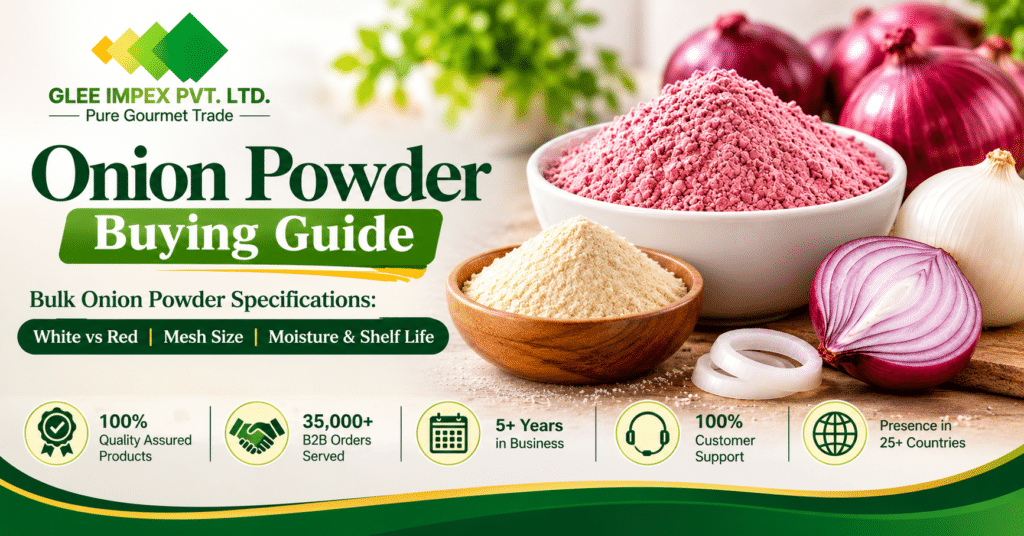
A Complete B2B Sourcing Guide to bulk onion powder specifications with 100% Quality Assured Products, 35,000+ B2B Orders Served, 5+ Years in Business, 100% Customer Support & Presence in 25+ Countries.
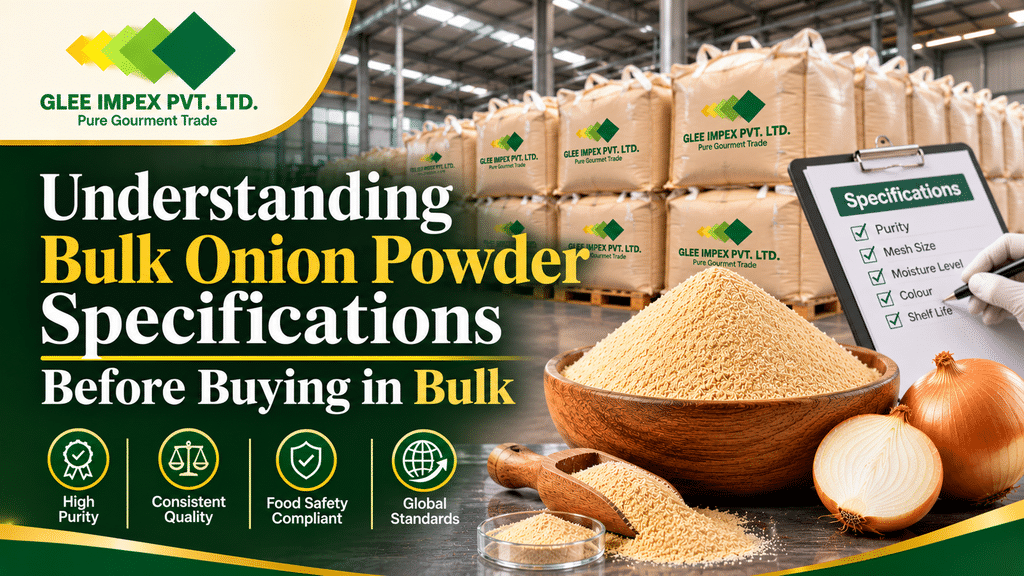
bulk onion powder specifications are among the most important factors to consider when purchasing onion powder for commercial food production, seasoning manufacturing, food processing, and international distribution. For businesses looking for consistent quality, competitive sourcing, and dependable supply, understanding onion varieties, mesh size, moisture content, and shelf life can make a significant difference. Glee Impex Pvt Ltd focuses on supporting B2B buyers with quality-oriented sourcing solutions, 100% Quality Assured products, 35,000+ B2B Orders Served, 5+ Years in Business, 100% Customer Support, and business reach across 25+ Countries.
Onion powder is a widely used dehydrated ingredient in the food industry because it delivers concentrated onion flavour, convenient handling, and a longer storage life than fresh onions. It is commonly used in instant foods, spice blends, sauces, snacks, ready-to-eat products, marinades, and seasoning formulations.
However, not every onion powder offers the same performance. White onion powder and red onion powder can differ in flavour characteristics, colour, and application suitability. Similarly, mesh size and moisture levels influence texture, blending performance, storage stability, and product consistency. Understanding these differences helps wholesale buyers make informed purchasing decisions.
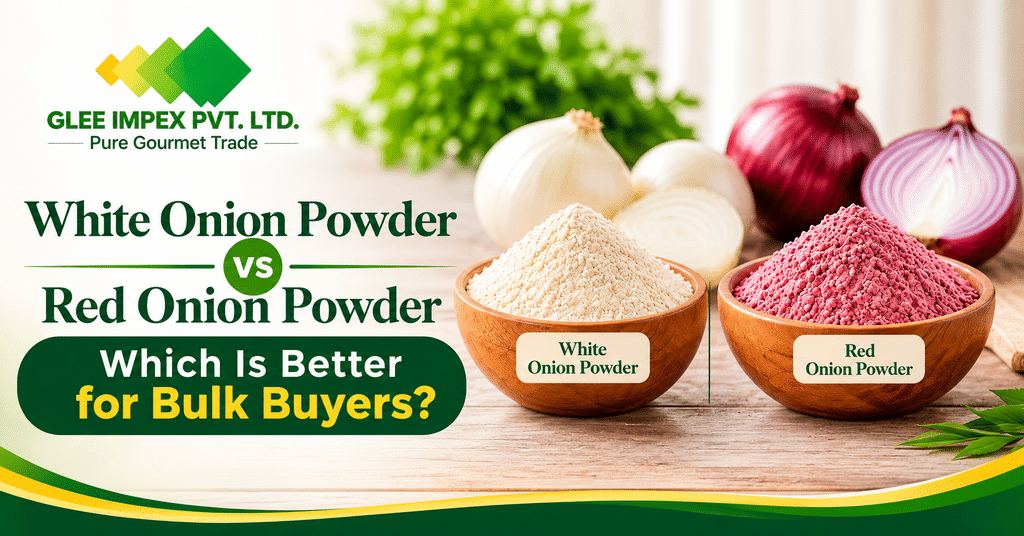
Choosing between white and red onion powder depends on the intended food application, flavour requirements, and colour expectations. Both varieties have commercial applications, but their characteristics can influence the final product.
White onion powder is commonly preferred for applications where a relatively mild, balanced onion flavour and lighter colour are desirable. It blends easily into many dry seasoning formulations and is suitable for food manufacturers that want onion flavour without significantly changing the appearance of their finished products.
White onion powder is frequently used in soups, sauces, instant noodles, snack seasonings, spice mixes, and processed food formulations. Its flavour profile makes it a practical ingredient for manufacturers producing products that require a consistent onion taste.
For businesses sourcing wholesale onion powder, white onion powder can be a suitable option when colour consistency and a balanced flavour profile are important.
Red onion powder is produced from dehydrated red onions and can offer a distinctive onion flavour along with a different natural colour profile. Depending on the raw material and processing conditions, the final powder may have light pink, reddish, or brownish tones.
It can be used in seasoning blends, specialty food products, spice formulations, and applications where the characteristic flavour and colour of red onions are desirable.
Buyers considering organic onion powder bulk should also evaluate the availability of certified organic raw materials, processing controls, and relevant certification documentation rather than assuming that a particular onion colour indicates organic quality.
The right choice depends on your target market and finished product requirements. White onion powder is generally suitable for lighter-coloured formulations, while red onion powder may be preferred for applications requiring a distinctive onion profile.
Before placing a commercial order, request a representative sample and evaluate its colour, aroma, flavour, and blending performance. This simple step can help reduce inconsistencies in large-scale manufacturing.
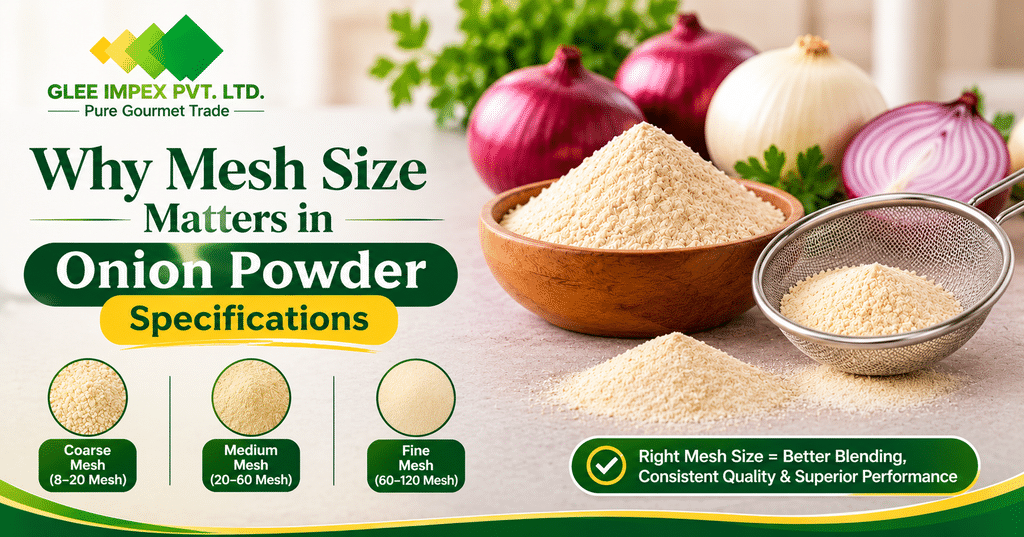
Mesh size is one of the most important technical considerations when purchasing onion powder in bulk. It refers to the particle-size classification of the powder and indicates how finely or coarsely the material has been processed.
Different food applications require different particle sizes. A fine powder may be appropriate for smooth seasoning blends, while a relatively coarse texture can be more suitable for products where visible particles are acceptable.
For example, 40 mesh, 60 mesh, 80 mesh, and 100 mesh are commonly referenced particle-size options in commercial powder sourcing. Actual particle distribution and sieve specifications should always be confirmed with the supplier.
A finer mesh generally produces a smoother texture and can support uniform distribution in dry seasoning blends. It may also disperse more easily in certain food formulations, depending on the other ingredients and processing conditions.
Coarser particles can provide a more noticeable onion texture and may be suitable for dry rubs, spice mixes, and selected snack applications.
Businesses purchasing granulated onion bulk should understand that granulated onion and onion powder are different product forms. Granulated onion contains larger particles, whereas onion powder has a finer consistency. The selection should depend on the texture and performance required in the finished product.
For large-volume buyers, it is important to specify the required mesh size, acceptable particle-size variation, and sieve-testing expectations before confirming an order.
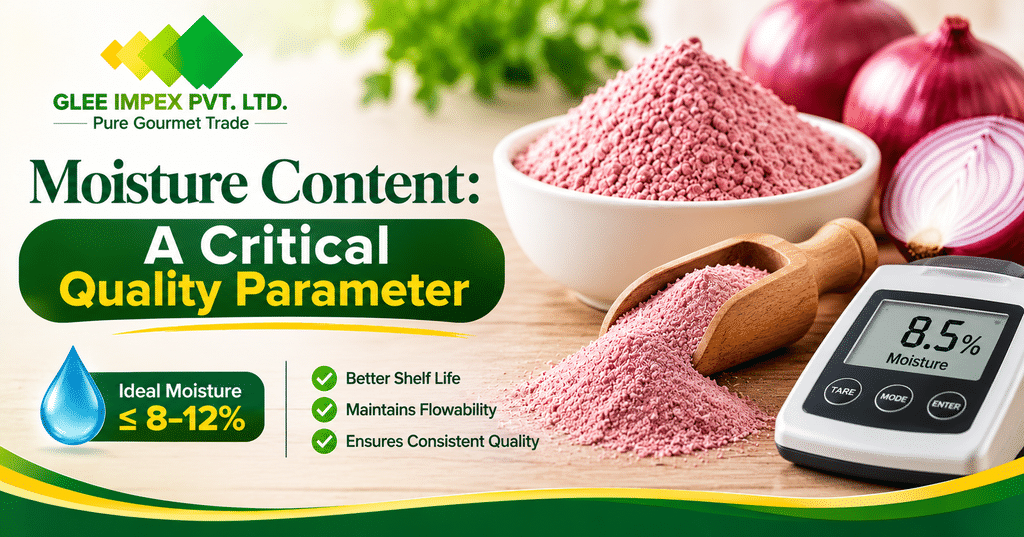
Moisture content directly affects the storage stability, flowability, texture, and handling characteristics of onion powder. Excess moisture can encourage caking, reduce product quality, and create conditions that may support microbial deterioration if other controls are inadequate.
Commercial buyers should always request a moisture specification and verify that the supplied product meets the agreed quality parameters.
For many dehydrated onion powder applications, buyers commonly discuss moisture levels around 5% to 8%, although the acceptable limit depends on product grade, processing method, intended use, and customer requirements. The exact specification should be confirmed through an agreed product specification sheet and suitable laboratory testing.
Low and controlled moisture levels help maintain the powder’s free-flowing characteristics during storage and transportation. They also support better handling in automated production systems.
When comparing onion powder wholesale price, buyers should avoid considering price alone. Two products may have similar pricing but different moisture levels, particle sizes, colour characteristics, and quality standards. These differences can affect actual manufacturing performance and purchasing value.
A reliable supplier should be able to provide relevant quality documentation, including moisture analysis and batch-specific test information where available.
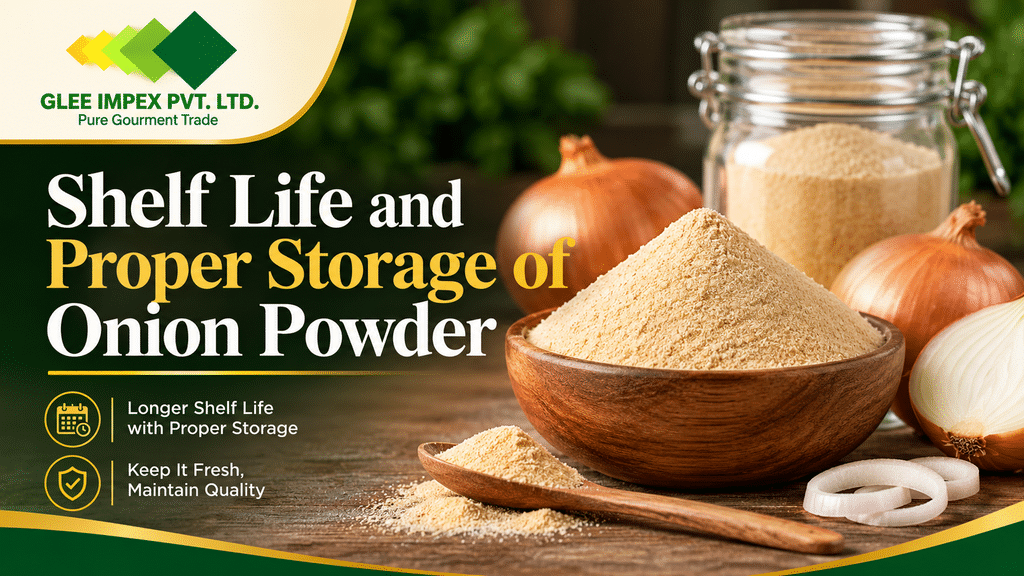
Shelf life is another important factor for importers, distributors, food manufacturers, and bulk ingredient traders. Although dehydrated onion powder generally has a longer shelf life than fresh onions, its quality can gradually change when exposed to moisture, oxygen, heat, and direct sunlight.
Under suitable packaging and storage conditions, commercial onion powder commonly has a shelf life of approximately 12 to 24 months. However, the actual shelf life must be established by the manufacturer based on product characteristics, packaging, testing, and storage conditions.
Proper packaging plays an important role in maintaining product quality. Moisture-resistant food-grade packaging helps protect the powder from external humidity and contamination. Suitable inner liners and sealed bags can further support product stability during transportation and warehousing.
Bulk buyers should store onion powder in a cool, dry, clean, and well-ventilated environment. Packages should remain properly sealed when not in use and should be kept away from strong-smelling materials because dehydrated powders can absorb external odours.
For businesses purchasing wholesale onion powder, checking manufacturing dates, best-before dates, batch numbers, and packaging integrity is essential before accepting a shipment.
Following the first-in, first-out (FIFO) inventory method can also help businesses manage stock efficiently and reduce unnecessary storage periods.

Apart from colour, mesh size, moisture, and shelf life, buyers should consider several additional quality characteristics before selecting a supplier.
The first is aroma. Quality onion powder should have a characteristic onion aroma without unusual or unpleasant odours. Its flavour should be representative of the raw material and suitable for the intended application.
The second is appearance. The product should have a reasonably consistent colour and particle distribution according to the agreed grade. Significant variation between batches may affect the appearance of finished food products.
The third is foreign matter control. Commercial food manufacturers should work with suppliers who follow appropriate cleaning, sorting, processing, and quality-control procedures.
Microbiological quality is equally important. Buyers should request relevant microbiological test reports based on their application and destination-market requirements. Depending on the customer specification, testing may include total plate count, yeast and mould, coliforms, and other relevant parameters.
For organic onion powder bulk, certification and traceability deserve additional attention. Buyers should verify valid organic certification, applicable processing requirements, and supporting documentation before purchasing products advertised as organic.
These checks help businesses establish consistent procurement standards and reduce the risk of receiving unsuitable material.

The onion powder wholesale price depends on several commercial and technical factors. Buyers should understand these variables before comparing quotations from different manufacturers, exporters, and ingredient suppliers.
Raw onion availability is one important factor. Seasonal production, agricultural conditions, and the availability of suitable raw materials can influence manufacturing costs.
Processing technology also affects pricing. Dehydration methods, milling processes, sorting, quality checks, and packaging requirements can contribute to differences between product grades.
Mesh size is another consideration. Different particle-size requirements may involve additional processing and classification, which can influence the final quotation.
Order quantity, packaging format, delivery destination, and shipping arrangements also affect the total landed cost. International buyers should consider freight, applicable duties, documentation, and other import-related expenses when evaluating supplier offers.
When comparing granulated onion bulk with finely milled onion powder, remember that the two products have different particle structures and applications. Their pricing should be evaluated according to the actual grade and processing requirements.
Instead of choosing a supplier based only on the lowest quotation, buyers should compare product specifications, sample quality, packaging standards, documentation, and supply consistency.
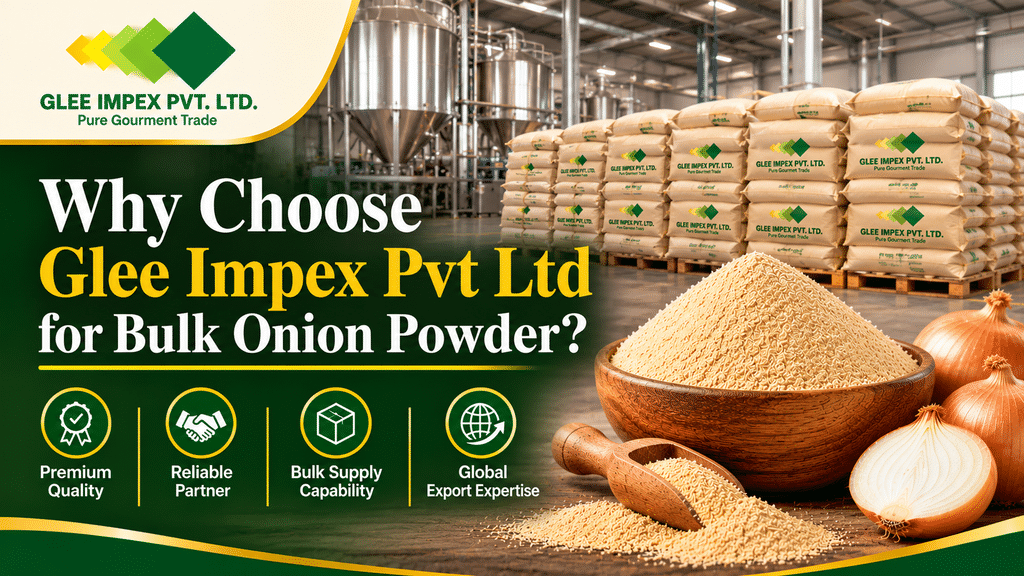
Selecting the right supplier is just as important as choosing the right product specification. A dependable B2B supplier should understand commercial purchasing requirements, product consistency, packaging expectations, and the importance of timely communication.
Glee Impex Pvt Ltd focuses on building business relationships through quality-oriented sourcing and customer support. With 5+ Years in Business, 35,000+ B2B Orders Served, 100% Quality Assured positioning, 100% Customer Support, and business reach across 25+ Countries, the company highlights its commitment to serving business buyers.
Whether you are a food manufacturer, seasoning producer, importer, distributor, or wholesale ingredient trader, selecting suitable onion powder requires attention to technical specifications and commercial requirements.
Buyers looking for wholesale onion powder should communicate their preferred variety, mesh size, moisture limits, packaging requirements, and order quantity before requesting a quotation. Clear specifications help suppliers understand the intended application and provide a more relevant product offering.
Businesses interested in organic onion powder bulk should also communicate their certification and documentation requirements in advance to ensure the offered product meets their purchasing standards.
Glee Impex Pvt Ltd aims to support B2B buyers with a customer-focused approach, helping them evaluate product requirements and identify suitable sourcing solutions.
White onion powder generally offers a lighter colour and a balanced onion flavour, while red onion powder can have a distinctive flavour and reddish or brownish colour characteristics. The ideal variety depends on the final food application.
The best mesh size depends on the manufacturing application. Fine mesh options are often preferred for smooth seasoning blends, while coarser particles may be more suitable for dry rubs and products requiring visible onion texture. Buyers should confirm the exact sieve specification with their supplier.
A moisture level around 5% to 8% is commonly discussed for dehydrated onion powder, but the acceptable specification depends on the product grade and customer requirements. Always verify the agreed moisture limit through appropriate testing.
Commercial onion powder may have a shelf life of approximately 12 to 24 months under suitable storage and packaging conditions. The actual expiry or best-before period should be confirmed from the manufacturer’s product documentation.
Compare the product variety, mesh size, moisture content, quality documentation, packaging, order quantity, and delivery costs. Comparing products with equivalent specifications provides a more meaningful price evaluation.
No. Granulated onion has larger particles and a coarser texture, whereas onion powder is finely ground. Both are used in commercial food production, but their applications can differ.
Understanding bulk onion powder specifications is essential for businesses that want consistent flavour, suitable particle size, controlled moisture, reliable shelf life, and efficient bulk procurement. From selecting white or red onion powder to evaluating mesh size, packaging, and quality documentation, every specification contributes to the performance of the final product.
For B2B buyers, a well-defined purchasing requirement can simplify supplier comparisons, improve inventory planning, and support long-term sourcing relationships. Always request samples, review product specifications, verify relevant certifications, and confirm the agreed quality parameters before placing large orders.
Glee Impex Pvt Ltd is focused on supporting commercial buyers through quality-oriented sourcing, customer support, and B2B business relationships. If you are planning to purchase onion powder for food manufacturing, seasoning production, distribution, or international trading, make product quality and specification transparency your first priority.
Connect with Glee Impex Pvt Ltd to discuss your bulk onion powder requirements, request product specifications, and explore suitable B2B sourcing opportunities.