To import makhana to USA in 2026, you need 5 things working together: an FDA-registered processing facility in India, the correct HS classification, US-compliant labels, an importer of record with a Foreign Supplier Verification Program, and a freight plan that protects a very moisture-sensitive product. Glee Impex Private Ltd, a Noida-based agro exporter with 100% Quality Assured products, 35,000+ B2B Orders Served, 5+ Years in Business, 100% Customer Support and buyers across 25+ Countries, wrote this guide to walk US distributors, snack brands and retailers through every stage of the process.
Makhana, also called fox nuts or lotus seeds, has moved from Indian kitchens to American health-food shelves in just a few years. It is light, crunchy, gluten-free and naturally low in fat, which makes it a strong fit for the US better-for-you snacking market. Getting it from a farm pond in Bihar to a warehouse in New Jersey, however, involves regulators on both sides of the ocean. The sections below explain each requirement in plain language so you can plan your first container with confidence.
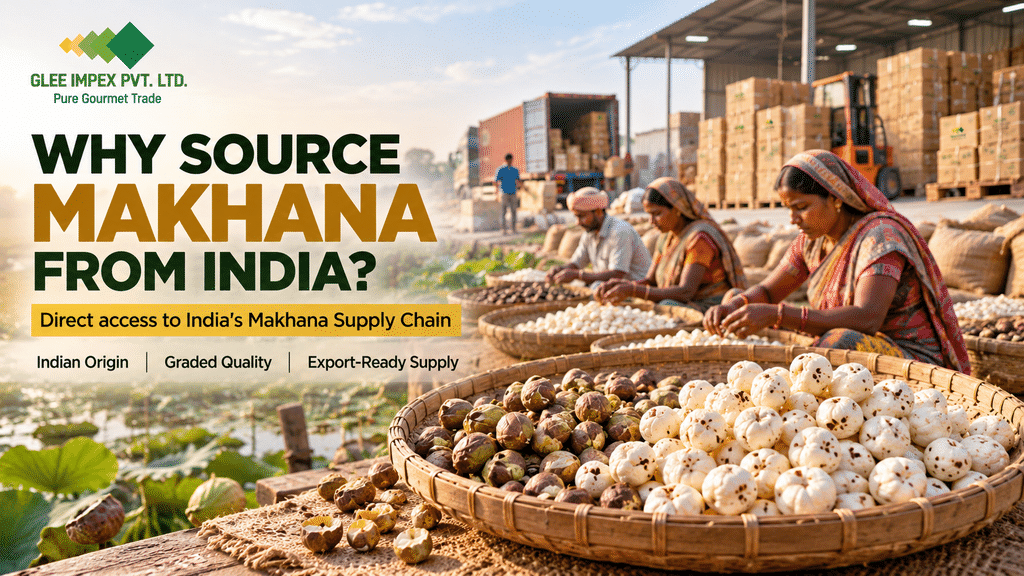
India grows the overwhelming majority of the world’s makhana, and Bihar alone accounts for nearly 85% of India’s production. That concentration gives Indian exporters direct access to farmers, processors and grading units, which keeps quality consistent and pricing competitive.
Export volumes are rising fast. During 2025-26, India shipped more than 7,000 metric tonnes of makhana and value-added makhana products to over 20 international destinations, with the USA among the key markets. For an American buyer, sourcing directly from an established Indian exporter removes middlemen, shortens the supply chain and gives you control over grade, size and packaging.

The first rule is simple: every facility that manufactures, processes, packs or holds food for US consumption must be registered with the US Food and Drug Administration. Registration must be renewed every 2 years, between October 1 and December 31 of each even-numbered year. Because 2026 is a renewal year, ask your supplier to confirm that their registration has been renewed before December 31, 2026, otherwise shipments can be refused at the port. A foreign facility must also appoint a US Agent and provide a Unique Facility Identifier, usually a DUNS number.
The second requirement is Prior Notice. Before any food shipment arrives in the USA, FDA must receive advance notice of it. For ocean cargo, Prior Notice must be submitted at least 8 hours before arrival, and for air cargo at least 4 hours before arrival. Your customs broker usually files this on your behalf, but the data comes from your exporter, so accurate paperwork from India matters.
The third requirement sits with you as the importer. Under the Food Safety Modernization Act (FSMA), the US importer must maintain a Foreign Supplier Verification Program, known as FSVP. This means you must analyse the hazards linked to makhana, evaluate your foreign supplier’s performance and verify that the food is produced safely. A good exporter will share FSSAI licensing, HACCP or ISO 22000 certification, and laboratory reports covering moisture, microbiology and pesticide residues so that your FSVP file is complete from day 1.

Classification errors are one of the most common reasons for customs delays. The good news is that makhana now has its own identity in the tariff schedule. From July 2025, India introduced dedicated codes: 20081921 for popped makhana, 20081922 for makhana flour or powder, and 20081929 for other makhana-based products. Your Indian exporter will use the correct makhana HS code on the shipping bill and commercial invoice.
On the US side, Customs and Border Protection uses the 10-digit Harmonized Tariff Schedule of the United States (HTSUS). Popped and prepared makhana generally falls under heading 2008, which covers nuts and other seeds that are otherwise prepared or preserved. The final 10-digit line depends on whether the product is plain, roasted, flavoured or mixed with other ingredients, so confirm it with your licensed customs broker. If you plan regular imports, you can request a binding ruling from CBP so that the same classification is accepted on every future entry.
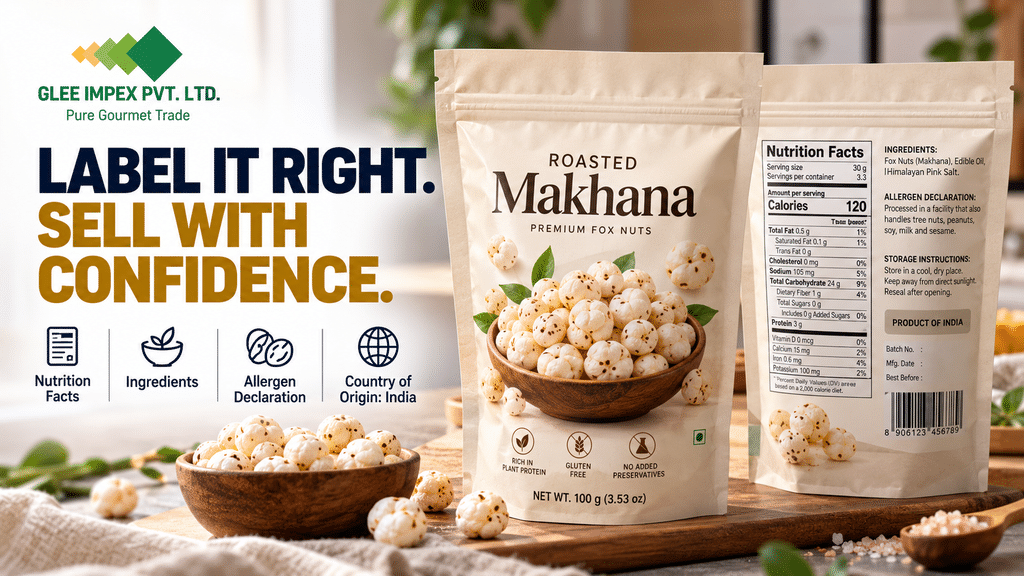
Every retail pack sold in the USA must carry an English-language label that meets FDA rules. The principal display panel needs a clear statement of identity, such as “Roasted Fox Nuts (Makhana)”, and a net quantity declared in both metric and US units, for example 100 g (3.5 oz).
The information panel must list ingredients in descending order of weight and show a Nutrition Facts panel in the current FDA format. Allergen labelling is critical. US law recognises 9 major food allergens, and sesame was added in January 2023. Plain makhana is not a major allergen, but flavoured varieties often contain milk powder, sesame or wheat-based seasoning, and each must be declared.
The label must also carry the name and address of the manufacturer, packer or US distributor, plus a country of origin marking such as “Product of India.” If you print claims like “high protein” or “low fat”, they must meet FDA nutrient content claim definitions. When you import raw makhana in bulk for repacking in the USA, the outer cartons need basic identification, but the final consumer pack must be fully compliant before it reaches store shelves.

US tariffs on Indian goods have changed several times in the last 18 months, so always check the current rate before you confirm a purchase order. Between August 27, 2025 and February 23, 2026, most Indian exports faced heavy additional reciprocal tariffs. In February 2026 the US Supreme Court struck down the reciprocal-tariff system, and a temporary 10% global tariff replaced it. Since July 24, 2026, Indian goods have faced a 10% tariff under Section 301 in addition to the normal MFN duty for the product.
In practice, your duty on makhana equals the MFN rate for its HTSUS line plus the additional 10%. On top of that, CBP charges a Merchandise Processing Fee of 0.3464% of the shipment value, subject to a minimum and maximum, and ocean cargo also attracts a Harbor Maintenance Fee of 0.125%. You will also need a customs bond, either single-entry or continuous. Add freight, insurance, broker fees and inland trucking to arrive at your true landed cost per kilogram.

Makhana is extremely light and bulky, so freight is driven by volume rather than weight. Most commercial orders move by sea from Nhava Sheva, Mundra or Kolkata to ports such as New York/New Jersey, Savannah or Los Angeles/Long Beach. Ocean transit typically takes 25 to 45 days depending on the route and coast. Air freight takes roughly 3 to 7 days and works well for samples or urgent top-ups.
For ocean shipments, an Importer Security Filing, also called ISF or 10+2, must be lodged at least 24 hours before the cargo is loaded at the origin port. Moisture is the biggest quality risk, because makhana loses its crunch quickly in humid conditions. Insist on multi-layer moisture-barrier liners, sealed cartons and desiccants, and choose nitrogen-flushed packs for retail-ready goods. Your document set should include a commercial invoice, packing list, bill of lading, certificate of origin and lab analysis report. If you are importing raw, unprocessed seeds, check with USDA APHIS whether a phytosanitary certificate is required.
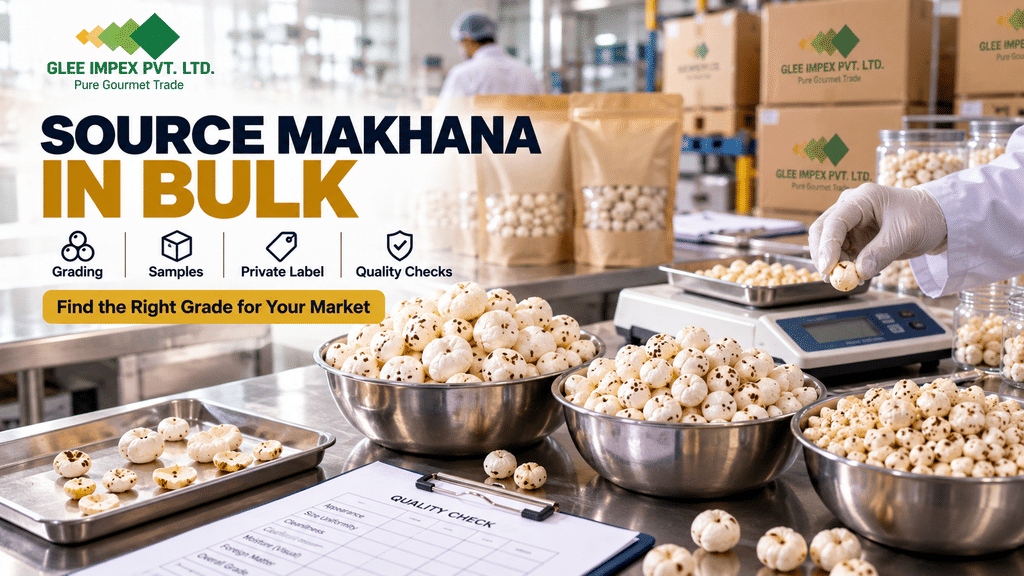
When you buy makhana in bulk, grade and size decide both price and customer experience. Indian makhana is graded by size, commonly sold as 4 suta, 5 suta and 6 suta, where larger seeds command a premium and suit retail snacking, while smaller grades work well for flour, kheer mixes and food service.
Before choosing a fox nuts wholesale supplier, request pre-shipment samples, a certificate of analysis for each lot and the supplier’s FDA registration number so you can verify it independently. Ask about minimum order quantities, private-label options and how they handle moisture control from grading to container stuffing. A supplier that answers these questions quickly and in writing is usually the one that will protect your shipment when something goes wrong.

Glee Impex Private Ltd combines direct sourcing from India’s makhana belt with export-grade processing and documentation. With 100% Quality Assured products, 35,000+ B2B Orders Served, 5+ Years in Business and active buyers in 25+ Countries, we understand what US customs, FDA and your end customers expect.
As a dedicated fox nuts wholesale supplier, we support you with graded raw makhana, roasted and flavoured options, private-label packing and complete export paperwork. Our 100% Customer Support means a real person helps you with samples, labelling questions and shipment tracking from enquiry to delivery. Whether you want to buy makhana in bulk for repacking or need retail-ready packs, our team will build a plan around your volume and timeline.
FDA does not pre-approve conventional foods like makhana. However, the processing facility must be FDA-registered, Prior Notice must be filed for every shipment, labels must be compliant and the US importer must maintain an FSVP.
Sea freight usually takes 25 to 45 days port to port, while air freight takes about 3 to 7 days. Customs clearance generally adds 2 to 5 working days if documents are accurate.
Moisture. Poor packaging can make makhana soft or mouldy during a 30-plus-day voyage, so moisture-barrier packing and lab-tested moisture levels are essential.
Success with makhana in the US market comes down to preparation: meet the FDA requirements for importing food from India, use the correct makhana HS code, print compliant labels, budget for 2026 duties and ship with moisture control in mind. Get these 5 pieces right and you can import makhana to USA smoothly, shipment after shipment. Ready to start? Contact Glee Impex Private Ltd at gleeimpex.com for samples, pricing and a quote tailored to your business