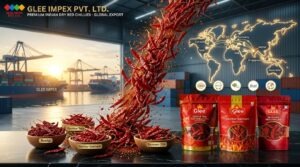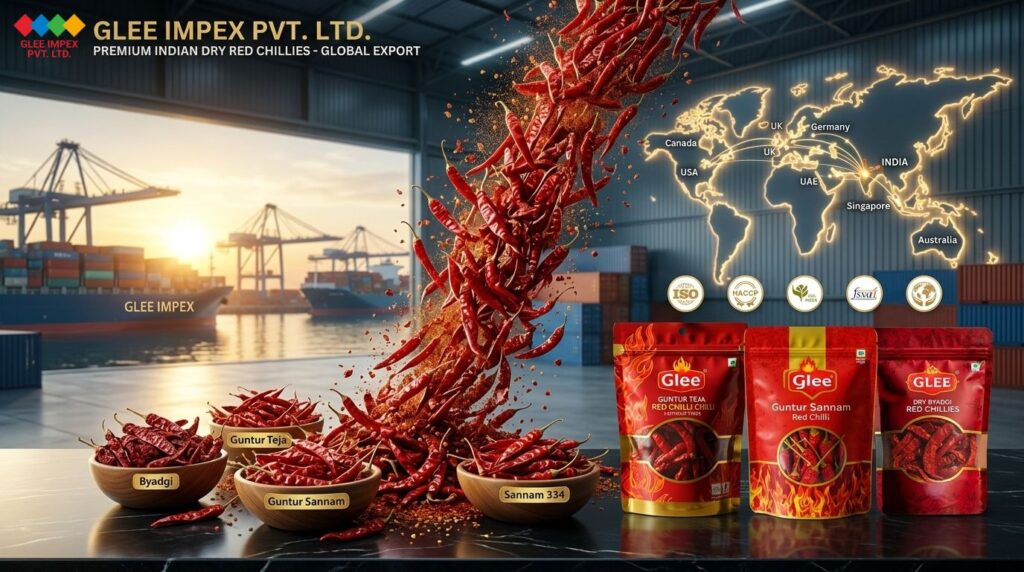
India kinda proudly stands as the world’s biggest producer plus exporter of red chillies, and it holds a really dominant spot in the global spice trade. In FY25 annual production is already above 1.5 lakh tonnes, and the expectations in 2026 are climbing even higher. So the Indian red chilli industry looks like a real powerhouse, not only for flavor and color but also for its economic value. For importers, food manufacturers, and distributors who need a dependable red chilli exporter, it becomes important to understand the whole picture— Indian chilli varieties, quality requirements , and export logistics—before making procurement calls that matter.
Glee Impex has also made a name for itself as a leading red chilli exporter, sort of focusing on the best Indian varieties like the spicy Teja and the flexible Sannam 334, plus the deep coloured Byadgi and the aromatic Kashmiri chillies. If you need whole dried red chillies, stemless pods, crushed flakes, or even a finer red chilli powder, then our export arrangement is set up with strict quality checks, full regulatory compliance, and real supply chain know-how that we manage every shipment with , hands on all the way.
In this overall guide, we look into what buyers actually need to know when they source from an experienced Indian chilli exporter: product specs, quality certifications, export paperwork, pricing movements, and why Glee Impex feels different in the competitive global spice market.
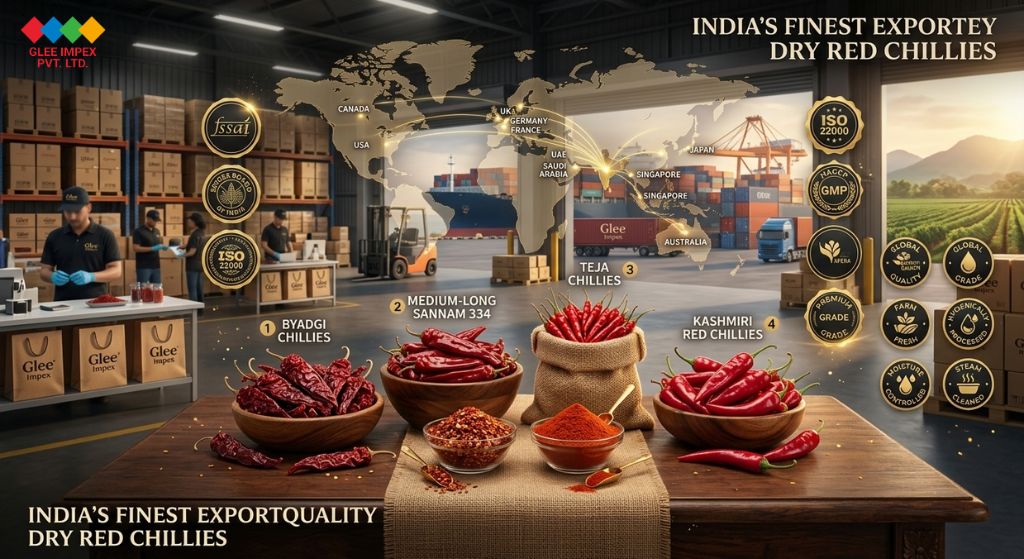
Glee Impex is kinda a top red chilli exporter from India, handling premium types like Byadgi , Sannam 334, Teja and Kashmiri chillies. The firm ships whole dried chillies, stemless pods, crushed flakes and also red chilli powder to places all over Asia, Europe , the Middle East and North America, with support from FSSAI, Spices Board , and ISO certifications.
Indian red chillies show up in separate varieties, each tuned for different culinary and processing uses. Byadgi brings deep color with gentle pungency, Sannam 334 gives balanced heat for world dishes, Teja delivers strong heat for hot sauce manufacturing, and Kashmiri chillies are prized for their vibrant color extraction properties.
Byadgi chillies grown mostly in the Haveri district of Karnataka are well known around the globe for their outstanding color value , and a heat level that stays pretty mild overall. They get the name from the Byadgi town in Karnataka, and they show a wrinkled skin look plus a deep crimson shade, which is why they’re often chosen for oleoresin extraction , paprika making, and basically for those color strong culinary uses.
Key Specifications:
Primary uses: oleoresin extraction, paprika powder, curry powders, food colorants sort of stuff
In the 2025–26 season, Byadgi chilli prices have gotten to historic highs, averaging between ₹50,000 and ₹70,000 per quintal because the export demand has been robust, and the harvest conditions were favorable. And as experienced Byadgi chilli exporters, Glee Impex sources directly from Karnataka’s best growing areas, so you get consistent color value, minimal foreign matter, and moisture levels that align with the strict expectations of European and American food manufacturers, without drama.
You might hear it as S4, Guntur Sannam, or even Indian Long Chilli, but in the end it’s that same Sannam 334 red chilli. It’s also pretty much the most commercially important chilli variety in India, taking up around 50–60% of the whole country’s chilli production. This one gets grown a lot across the Guntur, Prakasam, and Krishna districts in Andhra Pradesh, and that’s where the “sweet spot” happens , heat, color, and aroma all land in a balance global food processors actually want.
Key Specifications:
Pungency (SHU) :about 25,000–55,000, sits kind of mid to medium-high range
ASTA Color Value: around 100–140
Length: usually 10–14 cm , including the stem but more like 6–8 cm without it
Skin Texture: tends to look smooth to lightly wrinkled, though it is not overly rough
Moisture Content: Must be ≤ 12%
Capsaicin Content: comes in near 0.2–0.3%
Primary Uses, often chilli powder and spice mixtures, also curry paste, hot sauces, or even oleoresin extraction
Folks across Southeast Asian, Chinese, Mexican, and European cuisines seem to really value this chilli, a lot more than you might expect. The smooth skin texture makes cleaning, and machine handling more straightforward. Plus, the consistent size uniformity helps it fit the quality expectations of many major global retailers, without much fuss or delay.. Glee Impex supplies Sannam 334 in multiple grades—with stem, stemless, machine-cleaned, and double-cleaned variants—to match the precise specifications of food manufacturers and spice distributors.
Teja chillies (S17) represent the upper echelon of pungency in the Indian chilli portfolio.Mostly grown in the Guntur, and Warangal areas, Teja chillies show this fierce heat, a bold look, and a kind of semi-wrinkled feel. You could say this type is the raw ingredient that hot sauce makers prefer, along with capsaicin extractors and other industrial food processors who want that maximum heat concentration, all at once.
Key Specifications:
Pungency (SHU): 75,000–100,000+
ASTA Color Value : 90–180
Length : 6–8 cm
Skin Texture: Semi-wrinkled, bold, like it has a bit of texture going on
Primary Uses: hot sauce production, capsaicin extraction, pepper spray manufacturing, and industrial spice blends
Kashmiri chillies from North India usually get premium pricing for their standout color range (ASTA 180–220) and pretty low fire levels (SHU 2,000–4,000). They are used a lot for tandoori preparations, curry powder mixes, and as a food colorant, because the visual impact matters more than the heat intensity, mostly.
To export dried red chillies, reputable dry red chilli exporters really need to keep some hard quality parameters in check, like moisture content below 12% , foreign matter under 1% , and aflatoxin levels kept within EU limits (for example B1 ≤ 5 ppb) , plus pesticide residues lower than the MRLs set by the destination market. Also, you cant really “prove compliance” with only lab reports, buyers usually expect proper certifications. That is why FSSAI, Spices Board, ISO 22000 , and HACCP related certifications are commonly treated as mandatory for legal export, and for buyer trust.
Honestly, the single most critical quality parameter for dried red chillies is moisture content. If the moisture goes above 12% , then it starts enabling mold growth , and that can lead to aflatoxin contamination , plus insect infestation risks can increase, especially during long ocean transit. Glee Impex keeps moisture levels around 10–12% by using controlled sun-drying plus mechanical dehydration processes, then they finish with humidity-barrier packing and inner PE liners, so the product stays steady.
Aflatoxin contamination—particularly aflatoxin B1 produced by Aspergillus fungi—is the leading cause of spice shipment rejections at EU and US ports. Premium dry red chilli exporters must demonstrate:
Aflatoxin B1: ≤5 ppb EU standard
Total Aflatoxins: ≤10 ppb
Testing Frequency: Every batch, NABL accredited laboratory
Glee Impex does preharvest field monitoring , quick postharvest drying and cold storage preservation so the aflatoxin risk stays low. In addition every export consignment comes with a Certificate of Analysis (COA) from a recognized lab confirming it meets the destination market limits.
The EU , Japan , and USA keep tight Maximum Residue Limits (MRLs) for pesticides on spice imports. Ethylene Oxide (EtO) — a well known fumigant — is banned in the EU and yes it is a big cause of rejection risk . Glee Impex sources from farmers using only Spices Board-approved pesticides within permitted pre-harvest intervals, and conducts comprehensive pesticide residue screening before shipment dispatch.
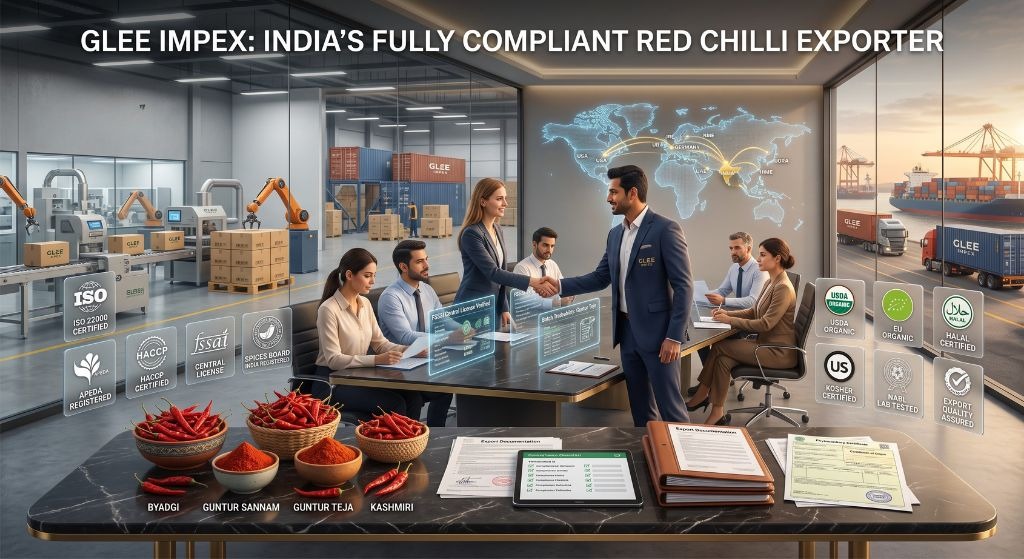
Most legit red chilli exporters in India end up needing an Import Export Code, IEC, from DGFT and a Central FSSAI license, plus Spices Board CRES registration. Extra certifications like ISO 22000, HACCP and BRC are actually a safer move, if you want premium buyers in the EU USA, and Japan.
The Food Safety and Standards Authority of India, FSSAI, acts as India’s equivalent to the FDA. Now any red chilli exporter in India that is processing, packing, or simply storing food products meant for export usually must hold a Central FSSAI license not just a basic registration. This license is basically a check that the hygiene level is maintained, labeling rules are followed, permissible additives are in control and pesticide residue limits stay within what is allowed. Buyers should, in practice always verify the FSSAI license number, by using the official FSSAI portal , before signing or committing to purchase orders.
The Certificate of Registration as Exporter of Spices (CRES) is mandatory under the Spices Board Act, 1986, and if you don’t have a valid CRES registration, then Indian customs wont clear your spice export shipment. In other words, without that registration in place, the whole process gets stuck. The Spices Board also does quality testing, issues health certificates and offers export promotion help , like buyer-seller meets and market development support. For the cost side, CRES registration is ₹5,000 for fresh applications and it usually stays valid for three years.
Even when export itself is not legally required for smaller deals, ISO 22000 along with HACCP certification has turned into kind of a real, practical condition for doing business with big food brands, retailers, and processors in places with strict rules. In general these certificates prove that the exporter keeps a structured food safety approach , built around hazard analysis, critical control points, lot tracking traceability, and also corrective and preventive action procedures.
FDA Food Facility Registration: needed for every shipment going to the USA
EU Organic / USDA Organic: needed when making organic spice claims
Halal certification: required for certain Middle Eastern and also Southeast Asian markets
Kosher certification: required for meeting Jewish dietary law compliance
BRC Global Standard: Required by major UK and European retailers
Fumigation Certificate: Required by multiple importing countries for phytosanitary compliance
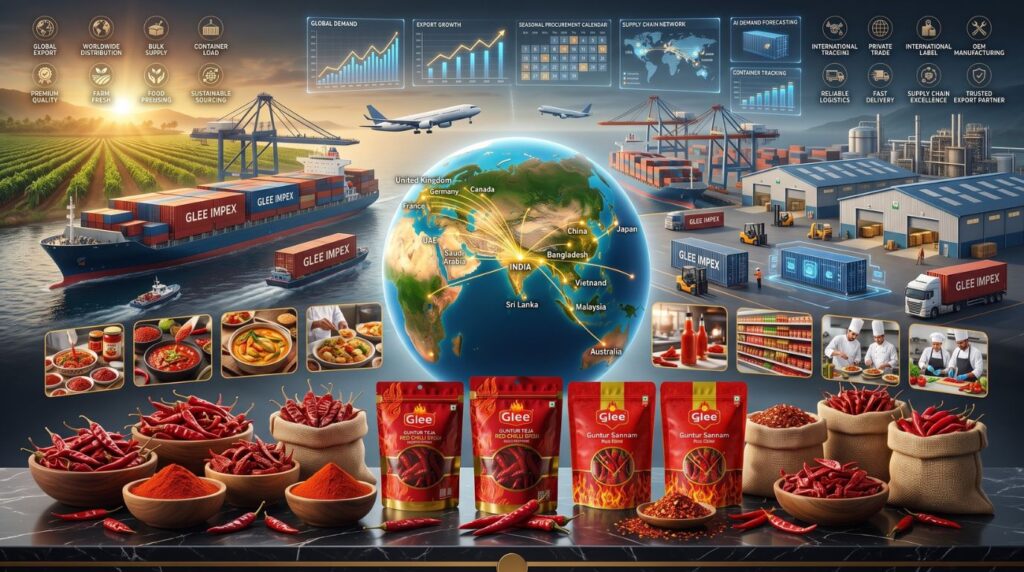
Major importers of Indian red chillies include China, Vietnam, Bangladesh, Sri Lanka, Thailand, the UAE, Malaysia, the USA, and EU nations. Demand is pushed by the global hot sauce boom, plus the steady rise in ethnic cuisines consumption, and also more people leaning toward natural colorant use in food processing. India’s chilli exports jumped in FY25 and 2026 projections point to more expansion still.
China: One of India’s largest buyers, importing massive volumes of dried red chillies for sauce production, paste manufacturing, and spice processing. Guntur Sannam and Teja varieties dominate Chinese procurement.
Vietnam: Imports Indian red chillies for domestic processing and re-exportation throughout Southeast Asia. Vietnamese processors particularly favor Sannam 334 for its balanced heat-to-color ratio.
Bangladesh: Proximity and cultural cuisine alignment make Bangladesh a top consumer of Indian red chillies, with steady demand for medium-heat varieties in traditional recipes.
Sri Lanka: Indian Teja and Sannam chillies are integral to Sri Lankan curry preparations and spice blends.
Thailand: The Thai food industry’s legendary heat preference drives consistent demand for high-pungency Indian varieties in curry pastes, sauces, and ready-to-eat products.
UAE and GCC: Rapidly growing food processing sectors and diverse expatriate populations create robust demand for Indian red chillies and red chilli powder across the Gulf region.
USA and Europe: The “hot sauce boom” and rising ethnic cuisine adoption have opened significant opportunities for Indian chilli exporters in Western markets, though these regions impose the strictest quality and documentation requirements.
Current dry red chilli prices in India (early 2026) range from ₹200–₹350 per kg across major markets, representing a 10–15% increase from 2025 levels due to sustained export demand. Guntur Teja commands ₹240–₹320/kg, Byadgi trades at ₹220–₹300/kg, and premium Kashmiri varieties reach ₹280–₹380/kg.
Seasonal Procurement Calendar for Buyers:
Strategic buyers align procurement with the January–March window to lock in favorable pricing before the lean season escalation.
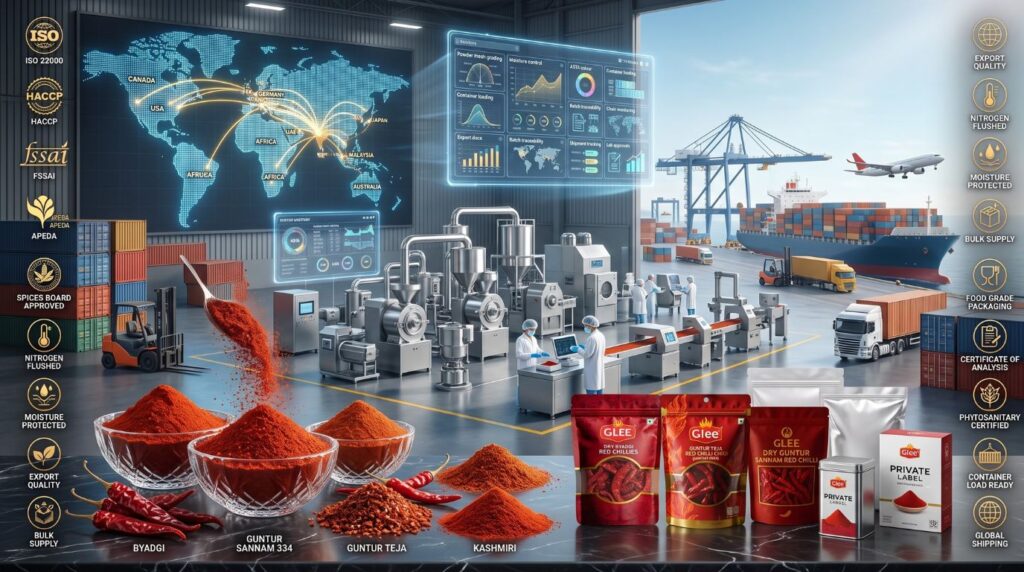
Leading red chilli powder exporters supply multiple mesh sizes (coarse, medium, fine) with ASTA color values of 40–140 depending on the raw variety. Powder exports require moisture barriers, nitrogen flushing, and food-grade laminated packaging to prevent oxidation and preserve color during transit.
Glee Impex produces red chilli powder across standardized mesh sizes:
Whole Dried Chillies:
Red Chilli Powder:
Container Loading Capacities:
Every Glee Impex shipment includes comprehensive documentation:
Glee Impex combines direct farm sourcing from Guntur, Byadgi, and Kashmir growing regions with in-house sorting, grading, and quality testing facilities. The company holds FSSAI Central License, Spices Board CRES, ISO 22000, and HACCP certifications, with documented export experience across Asia, Europe, the Middle East, and North America.
Glee Impex maintains direct procurement relationships with farming cooperatives in:
This direct sourcing eliminates intermediary markups, ensures traceability from farm to container, and enables quality control at the origin level.
Our processing facility features:
Glee Impex accommodates diverse buyer requirements:
Our client portfolio spans food manufacturers, spice distributors, restaurant chains, and retail brands across:
Importers should verify FSSAI and Spices Board registrations, request recent COA reports, inspect sample quality for moisture and foreign matter, confirm aflatoxin and pesticide compliance, evaluate packaging suitability for their climate, and assess the exporter’s documentation capabilities and track record in their target market.
Before committing to bulk orders, request samples and evaluate:
Sannam 334 (S4) offers medium pungency (25,000–55,000 SHU) with excellent color value, making it versatile for general cooking and spice powder production. Teja (S17) delivers extreme heat (75,000–100,000+ SHU) and is preferred for hot sauce manufacturing, capsaicin extraction, and industrial applications requiring maximum heat concentration.
Request and verify their FSSAI Central License number on the FSSAI portal, confirm Spices Board CRES registration, check IEC validity on the DGFT website, and ask for recent export documentation from completed shipments. Cross-reference their business registration with India’s Ministry of Corporate Affairs if dealing with a company structure.
Aflatoxins are produced by Aspergillus fungi that grow when moisture exceeds safe levels during drying or storage. Prevention requires rapid post-harvest drying to below 12% moisture, proper storage in ventilated, humidity-controlled warehouses, and regular batch testing. Reputable exporters provide aflatoxin test reports with every shipment.
Byadgi chillies tend to get a premium because they have a really high ASTA color score (150–200), plus they are grown in a narrow belt, most of it focused around Karnataka’s Haveri district. On top of that, there’s consistent, strong demand from the oleoresin and paprika extraction industries, and yes that pushes the market rate up. For the 2025–26 season, prices have already moved toward ₹50,000–₹70,000 per quintal.
For wet and humid destinations, go for multi-layer laminated pouches with an aluminum foil barrier, do a nitrogen flush to knock out oxygen, and keep an inner PE liner inside outer corrugated cartons. If you can, use vacuum-sealed packaging too , it adds extra defense against moisture entry and oxidation, especially when the shipment takes longer, like during extended ocean transit periods.
When stored well, meaning temperature under 25°C, relative humidity staying below 60%, and keeping them away from direct sunlight, whole dried red chillies usually hold quality for about 12–18 months. Red chilli powder is shorter , roughly 6–12 months, because color loss happens faster and the volatile oil compounds can oxidize earlier than you’d want.
Standard lead times are 2–4 weeks for ready stock and 4–6 weeks for custom-processed orders. Ocean transit adds 15–45 days depending on the destination port. Glee Impex provides accurate delivery schedules upon order confirmation and maintains buffer stock for urgent requirements.
Yes, but organic certification requires specific growing practices, separate processing facilities, and certification from accredited bodies like USDA Organic or EU Organic. Organic red chillies command 20–40% price premiums and require longer lead times d1. What is the difference between Sannam 334 and Teja chillies?
The leading causes include excessive pesticide residues (especially EtO in EU) , aflatoxin levels that exceed destination limits, moisture content above the agreed contract specs and also the presence of prohibited dyes (like Sudan dyes in chilli powder). On top of that, incomplete , or sometimes even questionable documentation can trigger rejections. By working with certified exporters who do pre shipment testing, most of the rejection risk is removed.
Glee Impex keeps comprehensive export insurance via ECGC (Export Credit Guarantee Corporation) , and we follow strict pre shipment inspection protocols. If a quality mismatch happens, even in rare cases, we look into it right away, arrange replacement dispatches or offer proportional refunds, and we keep refining our quality control system using buyer feedback.
Glee Impex accommodates trial orders starting at 1 MT for established buyers evaluating new supplier relationships. Standard commercial orders begin at 10 MT (one 20ft container partial load), with optimal pricing at full container loads of 18–26 MT depending on product form and packaging.
Absolutely. Glee Impex offers comprehensive private labeling services including custom pouch design, barcode integration, multilingual labeling, retail-ready packaging configurations, and brand-specific quality formulations. Our design team collaborates with buyer marketing departments to ensure packaging compliance with destination market regulations.
The global red chilli market is veering toward clean-label spice needs, more traceable supply routes, steam-sterilized products for microbiological safety and tighter control, oleoresin extraction momentum, plus sustainable agriculture routines. Indian exporters who sink effort in certification, practical tech, and farmer collaborations are in a strong place to win premium market share.
Food makers worldwide are swapping out synthetic colorants with natural alternatives, so demand is surging for high-ASTA chillies such as Byadgi and Kashmiri types. The natural food colorants market is expected to expand around 8–10% every year, while paprika oleoresin, and chilli extracts—are heading the growth portion.
Many top importers now insist on farm-level traceability paperwork, including blockchain style documentation. Glee Impex is implementing digital traceability systems that track each batch from specific farming cooperatives through processing, testing, and shipping—providing buyers with QR-code-accessible batch histories.
Steam sterilization—treating chillies with dry steam to eliminate microbial contamination without chemical residues—is becoming standard for EU and USA shipments. This process extends shelf life, ensures Salmonella compliance, and meets the clean-label expectations of premium food brands.
The global red chilli trade demands more than competitive pricing—it requires unwavering quality, regulatory precision, supply chain transparency, and deep market knowledge. As a dedicated red chilli exporter, Glee Impex kind of marries India’s richest chilli-growing heritage with modern quality systems, broad certifications, and a buyer-focused service mindset, so every shipment lands with that extra value, almost like it’s already tailored for you.
From the color rich fields of Byadgi , to the pungent harvests of Guntur, we source, process, and export the best Indian chillies, with the steadiness that global food manufacturers, spice distributors, and retail brands rely on day after day. Our FSSAI, Spices Board, ISO 22000, and HACCP certifications give the compliance base; our close farm connections plus in-house processing give the quality guarantee, and our logistics crew makes sure everything moves smoothly from India’s ports straight to your warehouse, with minimal delays.
Whether you’re looking for whole dried chillies, stemless pods, crushed flakes, or even premium red chilli powder, Glee Impex is ready to match your specific needs with competitive pricing , flexible arrangements, and that reliability that turns a supplier into an ongoing partner.
Get in touch with Glee Impex today to request samples, talk through your procurement requirements , and see why careful buyers across Asia, Europe, the Middle East, and North America choose us as their preferred red chilli exporter from India.ue to limited certified supply chains. Glee Impex can facilitate organic sourcing through our certified partner farms.